
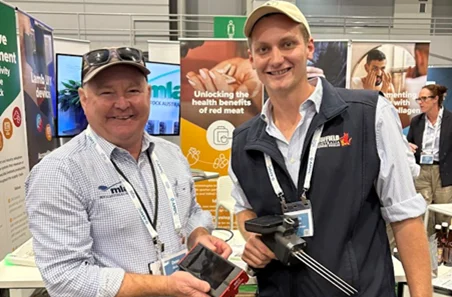
MLA’s Dean Gutzke and Cailan Byrnes holding the MEQ Probe at the AMPC Innovation Showcase in 2025.
CAILAN Byrnes didn’t grow up planning to revolutionise beef grading, but as the third generation running a vertically integrated grazing, processing and butchering operation in Far North Queensland, he understood early that what happens on the kill floor directly affects the bottom line.
Four years after transitioning from a career as an electrician, he’s now the Plant Manager of Rocky Creek Abattoir, overseeing 150 beef cattle and 100 pigs a week, supplying everything from Torres Strait hotels to Townsville restaurants and local supermarkets.
“Dad had a rule that we had to do two weeks in the plant every school holidays, so I was very acquainted with working in an abattoir,” Mr Byrnes said.
“I didn’t expect I would come back to the family business, but here I am and my skills from being an electrician and studying engineering at university have been transferable.”
Last year Mr Byrnes undertook a Nuffield Australia scholarship, backed by Meat and Livestock Australia to look at one of the industry’s most pressing gaps: whether beef grading cameras could be implemented and certified cost-effectively across any abattoir.
As part of his scholarship, he travelled to the US, Denmark, Ireland, New Zealand and throughout Australia to see what precision technology was already available and how it could be practically adopted for smaller scale processors.
“The main hurdle for smaller, family-run businesses like mine is to overcome the cost of not only buying the technology but having the infrastructure and staffing to maintain it and keep your certification,” Mr Byrne said.
“If we can get to the point where an objective measurement camera alone can accurately assess the meat it will be more scalable and cost effective for smaller businesses.
“Currently the technology must be used by a trained grader and the staff training required to be an accredited grader is quite extensive.
“Each grader must be trained, approved and retrained to stay current.
“Having the right people is what makes it difficult and expensive. But if you could just use technology, you could eliminate having to have those people.”
Technology exists, but need to make it accessible for smaller plants
Mr Byrnes said given Australia’s world-class grading system, a lot of the technology had been developed in Australia but used throughout the world.
“Australia hasn’t necessarily been the biggest purchaser of that technology, but Europe has really benefited from it and is using it in its plants,” he said.
“I went to Denmark and met with Frontmatec, a technology company that developed the handheld Q-FOM meat grading camera.
“It is based off AusMeat grading and has sold really well in Europe.”
Mr Byrnes said the cost and resourcing challenges required to meet accreditation standards in Australia made technology more realistic for smaller abattoirs.
“We are killing good cattle, but they all eat differently. But if we could differentiate the meat and put them into different brands it would allow us to have more consistent eating quality but also increase our profitability,” he said.
“I think if we could use the technology to differentiate the meat and not need any certification, as long as we didn’t promote it as MSA or AusMeat accredited, this would be an affordable option to remain competitive against the other beef brands that are out there.”
Mr Byrnes will present his findings at the 2026 Nuffield Australia National Conference in Darwin, from 8–10 September, where over 30 returning scholars will share research across the full breadth of Australian agriculture.
HAVE YOUR SAY