
Image: Journal of Archaeological Science: Reports (2026)
RURAL crime costs the Australian cattle industry millions of dollars each year, with offenders facing maximum prison sentences of 10–14 years and substantial fines, depending on the state or territory.
But modern-day cattle rustlers can still be thankful that some ancient penalties no longer apply.
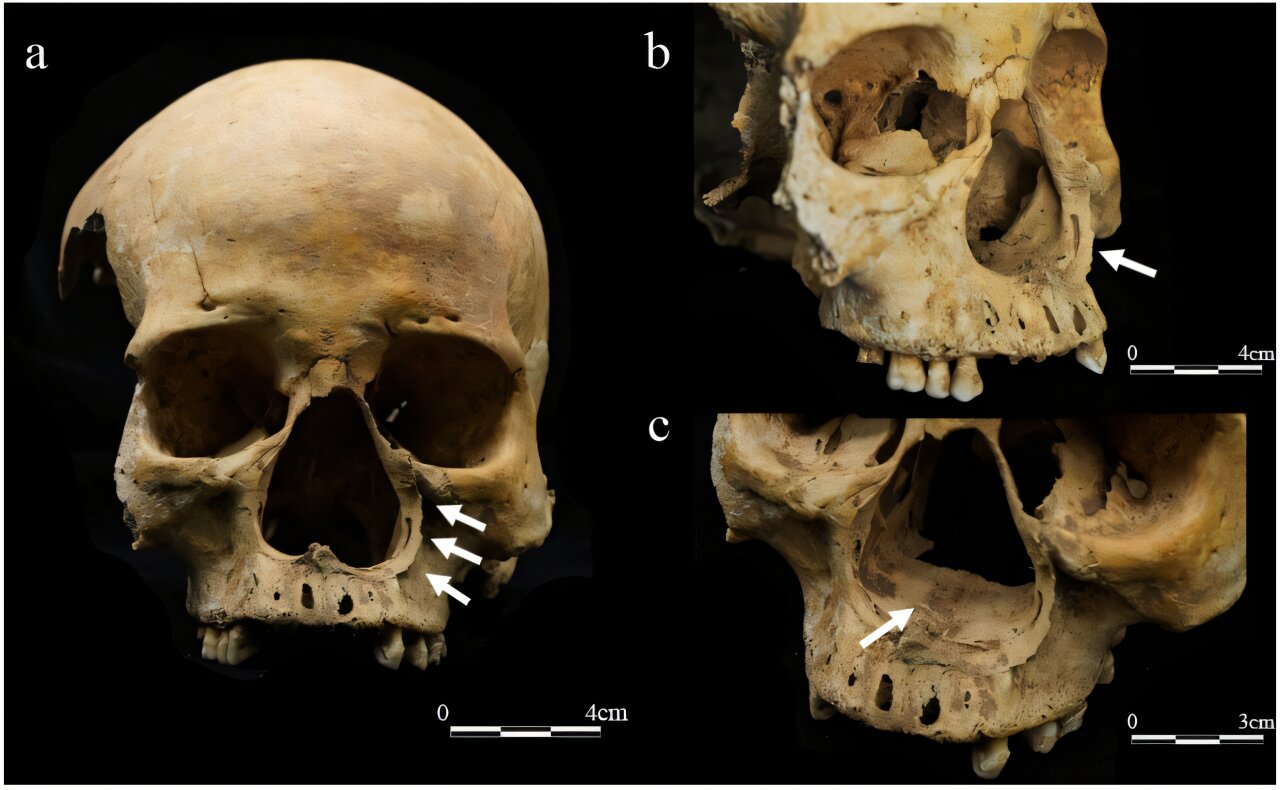
Archaeologists in China have published research documenting what may be the first physical evidence of “nose-chopping”, a historically recorded punishment for cattle thieves.
Nasal amputation appears in ancient texts as one of the infamous “five punishments” in the penal system of China’s Xia dynasty (2070–1600 BC) and was said to have been used primarily to punish livestock theft.
Until now, however, no physical evidence of the punishment had been discovered.
That may have changed after researchers led by Zhengzhou University’s Yawei Zhou used high-resolution CT scans to examine the remains of a woman excavated from the Sanzhiyuan Cemetery in China’s Henan province in 2019.
Radiocarbon dating indicated that she lived between about 1298 and 1404, spanning the late Yuan and early Ming periods. Analysis of her skull and pelvis suggested that she was aged between 40 and 45 when she died.
Of 213 historical burials examined at the site, hers was the only body buried face down and the only one displaying substantial facial disfigurement.
CT scans of the woman’s nasal cavity showed that parts of the nasal bones and several delicate internal structures had been severed, apparently by a cut made from the bottom upwards.
However, her front teeth remained intact and there were no surrounding fractures or signs of the blunt-force trauma that would typically be expected from a fall or accident.
“The most likely reason for midface disfigurement was punitive nasal amputation,” the scientists wrote in the Journal of Archaeological Science: Reports.
Bone growth around the nasal opening showed that the wound had healed, indicating that the woman survived for several years after the amputation.
Study co-author Qian Wang, a professor at Texas A&M University’s College of Dentistry, said the evidence suggested measures had been taken to stop the bleeding, prevent infection and manage her pain.
“Post-procedure patient care had allowed the individual to survive for years,” the researchers said.
Chemical analysis of her remains showed that she ate a relatively simple, millet-based diet containing little animal protein, suggesting that she was a commoner rather than a member of the wealthy elite.
“She had a normal diet for her time as a commoner and might have worn a nasal prosthetic to cover the scar, indicating that she attempted to return to normal life,” Professor Wang said.
However, her unusual burial may indicate that the stigma associated with her punishment continued after her death.
“Given that she was buried face down in an isolated area, she may have experienced discrimination from the community at large, if not from her immediate family,” Professor Wang said.
The researchers could not determine the woman’s identity or what offence she may have committed. While historical texts identify livestock theft as an offence punished by nasal amputation, the remains do not establish that the woman herself was a cattle thief.
For more information, see the study paper here.
HAVE YOUR SAY